Antitrust Case Briefing · United States v. Google LLC, No. 1:20-cv-03010 (D.D.C.)
The Google search ads antitrust case, explained for advertisers.
If your business bought Google search ads since 2016, this page is for you. It covers how the case came about, what the court decided about prices, what it left open, where the appeal stands, how advertisers are pursuing claims, who owns a claim, and what selling one involves.
By Turnpage Intelligence · Published October 13, 2026
The short version
Here's the whole story in a few sentences. A federal court found that Google is a monopolist in search text ads and used that position to raise what advertisers paid, through auction changes it rolled out quietly. The court didn't say how much anyone overpaid. Google is appealing, and the appeals court will hear the case in January 2027. An advertiser who wants money back has to prove its own damages in individual arbitration under Google's terms.
The current figures and dates are in the status box below.
Where the case stands — as of November 16, 2026
- 88% — Google's share of search text ad spending, as the court found it
- $150B+ — Spent on general search engine ads in 2021, according to the court
- 3× — How many times over federal law lets an injured business recover its proven damages
- 60 days — The wait after a notice of dispute before a claim can be filed under Google's terms
The case is United States v. Google LLC, No. 1:20-cv-03010, in federal court in Washington, D.C., before Judge Amit P. Mehta. The Department of Justice and eleven states filed it on October 20, 2020 (complaint). A second group of states filed their own case that December (Colorado v. Google LLC, No. 1:20-cv-03715), and the two were tried together over about ten weeks, from September to November 2023.
On August 5, 2024, the court found that Google holds monopolies in general search services and in general search text ads (opinion, ECF 1033). It ordered remedies on September 2, 2025 and entered a six-year final judgment on December 5, 2025 (ECF 1462). On November 10, 2026 the government told the court that the technical committee overseeing the judgment can't yet check Google's auction changes without data from its text ad auction (status report).
Google's appeal is in the D.C. Circuit, Nos. 26-5023, 26-5047 and 26-5049. Google filed its opening brief on May 22, 2026, the government answered on July 28, and the last briefs went in on October 29. The court has ordered argument for January 2027, with the day and the judges still to be named (order).
In the separate ad tech case, United States v. Google LLC, No. 1:23-cv-00108 (E.D. Va.), the court found Google liable on April 17, 2025 and ordered conduct remedies on September 2, 2026. The parties filed a proposed final judgment on October 2, 2026 (filing), and Google says it will appeal once the court enters it.
Advertiser claims go to individual arbitration before the American Arbitration Association under Google's U.S. advertising terms, which since July 1, 2026 allow batches of up to 100 similar demands (terms). Advertisers started filing in April 2026. No award has been made public.
The market
Every time someone searches on Google, an auction runs in the background to decide which text ads appear at the top of the page. When a business buys a Google search ad, that's what it's buying: a general search text ad.
It's an enormous market. Advertisers spent more than $150 billion on general search engine ads in 2021, and the court found that 88% of the money spent on text ads went to Google. (The figures are on pages 1 and 66 of the court's opinion.)
The case
In October 2020 the Department of Justice and a group of states sued Google under the Sherman Act, the main federal antitrust law. Their argument: Google had locked up its place as the default search engine on phones and browsers, through deals with Apple, Samsung and others, and used that position to raise ad prices.
After a ten-week trial in late 2023, Judge Amit P. Mehta agreed. On August 5, 2024 he ruled that Google is a monopolist in general search and in general search text ads, that it kept that position through its default deals, and that it used it to raise the price of text ads. In the court's words: "Google is a monopolist, and it has acted as one to maintain its monopoly."
The remedies came next. A remedies opinion followed on September 2, 2025 and a final judgment on December 5, 2025. The judgment bans exclusive default deals, makes Google share certain search data with qualified competitors and, in a section that matters to advertisers, makes Google report changes to its text ad auction and disclose them publicly or explain why not. That reporting hasn't started yet. In November 2026 the government told the court that the technical committee overseeing the judgment can't do that part of its job without data from Google's text ad auction (status report).
Google appealed in January 2026 and the government cross-appealed on the remedies. The last briefs went in on October 29, 2026, and the D.C. Circuit has ordered argument for January 2027.
What the court found about prices
This is the part that matters most if you bought the ads.
Google's own records describe three auction "knobs" it turned to raise prices, a program it called "intentional pricing". The court walked through each of them on pages 83 to 91 of the opinion.
- Squashing inflates the runner-up's score in the auction, so the winner has to pay more to keep the top spot.
- Format pricing turned sitelinks and other ad extensions, once free, into something Google charged for from 2017, after tests showed advertisers wouldn't leave. One internal note reads: "We've launched things at 15% and heard nothing." Format pricing grew to about 20% of text ad revenue per thousand queries.
- rGSP, from 2019, randomly swaps the top two bidders' scores, so the leader has to bid more to win for sure. Google's own pre-launch tests put the effect at a 5.9% rise in top-slot cost per click on computers and tablets and 4.9% on phones. Advertisers can't opt out of it.
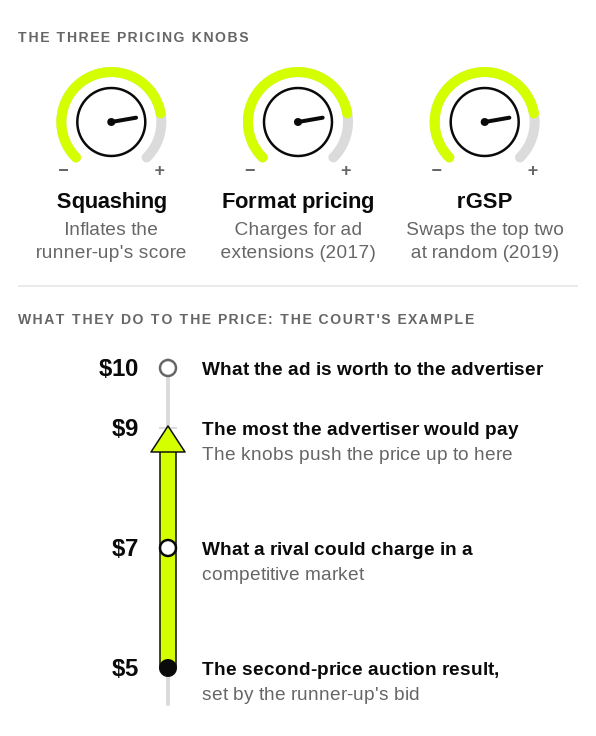
How the knobs move the price, in the court's own example (pages 262 and 263 of the opinion, in whole numbers).
Now here's where it gets interesting. Google tested how much advertisers would absorb, then rolled the changes out quietly. Its own research found that when prices went up, advertisers blamed themselves, their competitors or the season 85% of the time. Not Google.
The court's conclusion: Google "has profitably raised prices substantially above the competitive level", and did it "through barely perceptible and rarely announced tweaks to its ad auctions". At trial, Google's head of ads had put it more simply: "we tend not to tell advertisers about pricing changes" (Bloomberg, September 18, 2023).
The court declined to set the overcharge amount or opine on the broader search ad market beyond text search
First, the court never put a number on the overcharge. The government asked for changes to Google's conduct, not money damages, so the opinion finds that prices were raised above the competitive level without saying by how much. The percentages in the record are the sizes of individual price changes, not a finding of how far prices sat above a competitive level. In other words, each advertiser has to prove its own overcharge. The nearest thing to a court-endorsed benchmark comes from the ad tech case (discussed below).
Second, the ruling covers general search text ads only. The court found no monopoly in the broader search advertising market that includes Shopping ads, and it noted that Shopping ad prices stayed flat or fell from 2016 to 2020 while text ad prices climbed. It says nothing about YouTube or display spend. And it doesn't separately deal with text ads shown on Google's Search Partner sites or with spend routed through Performance Max, so how much of that spend counts is an open question.
And nothing is final until the D.C. Circuit rules. A reversal on liability would pull the foundation out from under every advertiser claim. An affirmance would make the liability finding permanent, but it still wouldn't add a damages number.
The ad tech case
There's a second case that deals with display ads.
On April 17, 2025, Judge Leonie M. Brinkema in Virginia ruled that Google monopolized the publisher ad server and ad exchange markets for open-web display advertising, and unlawfully tied the two together (opinion). But the judge found that the plaintiffs failed to prove an advertiser-side market. So the theory underlying display claims rests on a different and weaker theory than the search text ad claims.
On September 2, 2026 the court rejected a breakup of Google and ordered six years of conduct remedies (order; opinion, unsealed September 16; Department of Justice release). The parties filed a jointly proposed final judgment on October 2, and Google says it will appeal once the court enters it.
A floor for the overcharge, from the ad tech case
The search court didn't put a number on the overcharge. The ad tech court did, in its own market, and that number is the closest thing in the public record to a floor for what Google's pricing power has cost its customers.
Here's the finding. Judge Brinkema held that AdX's 20% take rate, the cut Google keeps on each open-web display transaction, was a supracompetitive price and direct evidence of monopoly power. Her opinions give two benchmarks for a competitive rate. Google's own employees recognized that rival exchanges "often charged closer to 10%" (page 77 of the liability opinion). And by the calculation of the government's economist, Tim Simcoe, removing just one of the unlawful practices, Unified Pricing Rules, would have brought AdX's rate down from 20% to about 16.6%, a level the court called comparable to AdX's competitors and that Google's own expert agreed was comparable (pages 59 to 60 of the remedies opinion). The remedies opinion calls the gap an "overcharge" and says it "fell most acutely on Google's publisher customers and advertisers" (page 30).
The arithmetic is ours, but it's short. Against the 16.6% benchmark, the overcharge is 3.4 cents of every dollar that moved through AdX. Against the 10% benchmark, it's 10 cents. That is where the 3% to 10% range in market estimates comes from, and the narrow end of it is the one the court endorsed.
Why does a display number matter to a search advertiser? Three reasons.
First, it's the only competitive benchmark either court has adopted. The search opinion describes the price increases Google tested and rolled out, 5% to 15% at a time with about half of each increase sticking, but it declines to say how far prices ended up above a competitive level. The ad tech opinions do say.
Second, Google's position in search text ads is stronger than its position in display. AdX handled 54% to 65% of its market and still had to compete with rival exchanges and header bidding; the court found it cutting its take rate to 15% or less on contested impressions and charging 25% or more where competition was thin, to hold a 20% average. In search text ads Google took 88% of spending, and the court found no rival constrained its pricing at all. A firm that could sustain a three- to ten-point overcharge in the more competitive market is unlikely to have taken less in the less competitive one.
Third, the money lands differently. The AdX fee comes out of the publisher's proceeds, so the court said the display overcharge fell on publishers and advertisers without dividing it between them. A search text ad has no middleman. The advertiser pays the auction price directly, so whatever the overcharge is, the advertiser bears all of it.
The search record points the same way. Format pricing alone had grown to about 20% of Google's text ad revenue per thousand queries by the time it was replaced; rGSP added roughly 5% to top-slot prices on top of that; and the court's own illustration, on pages 262 and 263 of its opinion, has Google pushing an ad that a second-price auction would price at $5 toward the $9 the advertiser would pay at most, where a rival in a competitive market could charge $7.
There's a fair objection to all of this. Display and search are different markets with different products, a finding about one isn't evidence about the other, and Google argued in both cases that its prices should be judged after adjusting for quality. An arbitrator isn't bound by any of it. But the question an arbitrator has to answer is what a competitive price would have been, and the ad tech record is the only place a court has accepted an answer. We read it as a floor to reason from, not a damages figure, and nothing here replaces the economist each claim will need.
Does the ruling carry over to arbitration?
Advertiser claims lean on Judge Mehta's findings, so a fair question is whether Google has to fight them all over again in every arbitration. Nobody knows yet. But there are early signs.
The first comes from court. On June 30, 2026, in Yelp's own antitrust suit against Google in California, the court barred Google from relitigating two of Judge Mehta's findings: that general search is a market, and that Google held monopoly power in it from 2009 through August 5, 2024 (order). It did that even though the appeal is still pending. It stopped at the date of the ruling, though, so in that case anything after August 5, 2024 has to be proven with fresh evidence. The court refused to do the same for the broader search advertising market, and Yelp didn't ask about the text ads market, so the order doesn't reach it.
Arbitration works differently. Google's terms say an arbitration ruling has no preclusive effect for any other advertiser. In other words, an early win for one advertiser doesn't bind the arbitrator in the next case. Each claim still has to stand on its own.
And a class action isn't a way around any of this. In the separate ad tech litigation in New York, the court refused in December 2025 to certify a class of advertisers, partly because whether each advertiser had agreed to arbitrate would have to be decided one by one (opinion).
Where advertiser claims go
Google's U.S. Advertising Program Terms send every dispute to individual arbitration before the American Arbitration Association, and waive class actions. The only way out was to opt out within 30 days of first accepting a version of the terms that included arbitration, which for most accounts was back in 2017.
The process starts with a written notice of dispute to Google. Then a 60-day wait. Only after that can a demand be filed.
The terms changed on July 1, 2026 (Google's notice). When 25 or more similar demands are filed with the help of one firm or coordinated group, the AAA now handles them in batches of 100, with one arbitrator per batch, and each side pays its own lawyers' fees and costs unless a claim is found to be frivolous. Under the old terms, Google covered the AAA fees on claims of $75,000 or less and capped an advertiser's share at $200 on claims up to $300,000. Above that, the AAA's fee schedule applies. Awards are confidential, and one advertiser's award doesn't bind the next.
What can an advertiser recover? Federal law lets a business injured by an antitrust violation recover three times its damages, plus costs and a reasonable attorney's fee (15 U.S.C. § 15). Claims usually have to be brought within four years (§ 15b). But that clock stops while a government antitrust case about the same conduct is pending, and for a year afterward (§ 16(i)). The government sued in October 2020, which is why the firms filing these claims count spend from 2016. How far back your claim reaches is a question for your lawyer.
Advertisers began filing demands in April 2026. Bloomberg reported an estimate of $218 billion or more in potential claims across search and display, built by an economist retained by the lead filing firm, and that firm's statement that comparable mass arbitrations took 12 to 24 months from filing to resolution. Google called the claims "unfounded". Alphabet's latest quarterly filing doesn't mention the arbitrations by name. For private claims that follow the government cases, it says it can't estimate a possible loss.
Who owns a claim
The claim belongs to the business that bought the ads from Google. Federal antitrust law lets the direct buyer recover the whole overcharge, and Google can't defend by arguing that you passed the cost on to your own customers.
Agencies make this harder. If an agency ran your ads in its own account, Google's terms have the agency promise that it has bound each advertiser it buys for to the same terms. So you're bound to arbitrate even if you never clicked accept yourself, and the 30-day opt-out could be used by your agency on your behalf or by you directly. Who holds the claim, you or the agency, depends on how the agency bought: as your agent, passing the cost through, or on its own account, reselling the ads to you at a markup. That question isn't settled for these claims, and it's worth sorting out before anyone files or sells.
A few other points:
- The arbitration clause also covers affiliates, parent companies, successors and assigns, so a claim that came with an acquired or merged business is still under it.
- Each month's spend is its own purchase, so a claim is built month by month from your billing records.
- Google's terms require an agency to give each advertiser it buys for monthly reports showing the dollars spent on Google. If an agency ran your account, ask for those reports now.
What Google will argue
Google has called the claims unfounded, and it has several lines of defense. Expect to hear all of them.
- The appeal. If the D.C. Circuit reverses on liability, the claims lose their footing. That's the biggest single risk, and it'll be decided first.
- Its own terms. Google's terms cap its liability at what the customer paid in the 30 days before the problem began, and say a customer gives up any dispute over charges it doesn't raise within 60 days of the invoice. Both apply only "to the fullest extent permitted by law", and there's a good argument that a contract can't shrink a federal antitrust claim this way. No public ruling has applied either clause to one of these claims yet.
- Quality. Google argues that its ads got better as they got pricier, so the real, quality-adjusted price didn't rise. Judge Mehta wasn't persuaded. He found that the evidence that quality-adjusted prices held steady, "let alone decreased, is weak".
- The benchmark. Any overcharge figure borrowed from the ad tech case will be met with the argument that display and search are different markets. That's the fair objection we flagged above.
None of this has been tested in public in an advertiser arbitration. In other words, these are the arguments, not the results.
What has to happen next
Three things, in roughly this order.
- The D.C. Circuit hears Google's appeal in January 2027 and then decides it. Appeals courts set themselves no deadline, so the decision could take months.
- Arbitrators decide the first advertiser claims, batch by batch. Each one needs proof of what the advertiser would have paid in a competitive market.
- Payment follows awards or settlements that survive any challenge in court. A party that wants an award thrown out generally has three months to ask a court to do it.
Apart from the argument month, no timetable has been set for any of it, and arbitrators may wait for the appeal, since the claims lean on the ruling.
One practical point. Since June 1, 2026, Google Ads keeps daily and weekly reporting data for 37 months and monthly data for 11 years (Google Ads Help). Spend from 2016 to 2022 may now exist only in your invoices and your agency's records. If you're thinking about a claim, preserve those now.
If you're thinking about selling
If your business bought Google search text ads in the United States since 2016, you may hold a claim. What it will recover is unknown and highly speculative, and it will take years. Some holders would rather not wait. Here's how a sale works.
What's sold is the right to whatever the claim recovers. It's a true sale, not a loan. The buyer pays a fixed amount at closing and takes on the wait, the costs and the risk that the claim recovers little or nothing.
If you've already signed with lawyers, you can still sell, but read your engagement letter. Some count a sale of the claim as a recovery, so the full contingency fee would come out of the sale price. Others are a bit more squishy about how much the law firm can take from the sale. Interested in exploring a sale? Our Google Ads claims page walks through the options.
Common questions
Is there a Google Ads class action settlement?
No. Google's advertising terms require individual arbitration and waive class actions, so there's no class settlement to join, and each advertiser's claim is filed and decided on its own. Since July 2026, similar claims can be heard in batches, but they're still separate claims. In the separate ad tech litigation, a New York court refused in December 2025 to certify a class of advertisers, partly for that reason.
How much did Google overcharge advertisers?
The court didn't say. The government asked for changes to Google's conduct, not damages, so the opinion says prices were raised above the competitive level without putting a number on it. Each advertiser has to prove its own overcharge in arbitration. The ad tech case offers a benchmark: the court there found Google's 20% ad exchange fee was supracompetitive against competitive rates of about 16.6% to 10%, a gap of roughly 3 to 10 cents on the dollar. We treat that as a floor to reason from for search, not a finding about search prices.
Does Shopping, Performance Max, YouTube or display spend count?
The search ruling covers general search text ads. The court found no monopoly in the broader market that includes Shopping ads, and the ad tech ruling found no advertiser-side monopoly, so display claims rest on a weaker theory. Neither ruling says anything about YouTube. The opinion doesn't separately deal with text ads on Google's Search Partner sites or with spend routed through Performance Max, so how much of that counts is an open question.
When will the appeals court hear Google's appeal?
In January 2027. The D.C. Circuit, where the appeals are consolidated under Nos. 26-5023, 26-5047 and 26-5049, has ordered argument for the first suitable date that month. As of the status date above, the day and the judges hadn't been named. Briefing finished on October 29, 2026. A decision follows argument, with no deadline.
Who can bring a Google Ads antitrust claim?
A business that bought Google search text ads under Google's U.S. advertising terms, generally from 2016 on. The claim belongs to the party Google billed. If an agency bought the ads in its own account and rebilled you, who counts as the purchaser depends on how the agency bought, and needs to be worked out. Businesses outside the United States are under different terms and different laws.
If my agency bought our Google ads, who owns the claim?
It depends on how the agency bought. If it acted as your agent and passed the cost through, the claim is likely yours. If it bought on its own account and resold the ads to you at a markup, it may hold the claim itself. That line isn't settled for these claims. Either way, Google's terms bind you to arbitration through the agency, and require the agency to give you monthly reports of what was spent on Google.
Why does spend back to 2016 count?
Antitrust claims usually have to be brought within four years. But that clock stops while a government antitrust case about the same conduct is pending, and for a year afterward. The Department of Justice sued in October 2020, so the firms filing these claims count spend from 2016. How far back your own claim reaches is a question for your lawyer.
Does Google Ads spend after August 2024 count?
It can be claimed, but it may be harder to prove. Judge Mehta's findings describe the market up to his ruling on August 5, 2024. When a California court let Yelp rely on them, it stopped at that date, noting that the findings are "aging quickly" with the arrival of generative AI. Later spend is likely to need its own evidence.
What are treble damages?
Federal antitrust law lets a business injured by a violation recover three times the damages it proves, plus the costs of the case and a reasonable attorney's fee. The multiplier is fixed by law. The damages themselves still have to be proven.
What happens to advertiser claims if Google wins its appeal?
The claims rest on the finding that Google monopolized search text ads and raised prices. If the D.C. Circuit reverses on liability, that foundation goes: claims already filed would have to be proven from scratch, and most would likely be dropped. If the ruling is affirmed, the liability finding becomes final, but it still adds no damages number.
How long will a Google Ads arbitration take?
Nobody knows yet. The appeal will be argued in January 2027, and arbitrators may wait for the decision, since the claims lean on the ruling. The firm filing the most claims has said that comparable mass arbitrations took 12 to 24 months from filing to resolution. An award can then be challenged in court before any money moves.
What does an arbitration cost?
More than most people expect. The American Arbitration Association charges filing and case fees that scale with the amount claimed, the arbitrator bills for time, and proving an overcharge takes an economist. Under the terms Google published for July 2026, each side pays its own lawyers' fees and costs. Under the old terms, Google covered the AAA fees on claims of $75,000 or less and capped an advertiser's share at $200 on claims up to $300,000. Lawyers working on contingency take a share of the recovery, and the experts and arbitration costs come out on top of that.
Can an advertiser still opt out of arbitration?
No. The opt-out had to be filed within 30 days of first accepting a version of the terms that included arbitration, which for most accounts was in 2017. The July 2026 changes came with their own 30-day window to reject them, and it has closed.
What records should an advertiser keep?
Everything that shows what you paid Google for search text ads, and when: invoices, billing exports and monthly spend reports, by campaign type and year, plus your Google Ads customer IDs and your agency's records if an agency ran the account. Google's terms require agencies to give advertisers monthly reports of what was spent on Google. Since June 1, 2026, Google Ads keeps daily and weekly reporting data for only 37 months, and monthly data for 11 years, so older detail may now exist only in your own files.
Can I sell my Google Ads antitrust claim?
Yes. The right to a claim's proceeds can be sold in a true sale. You get a fixed amount at closing, sometimes with a share of any recovery above an agreed threshold, and the buyer takes on the wait and the risk. Turnpage places such claims with its capital partners and advises holders who would rather pursue them. The options are set out on the Google Ads claims page.
Can I sell my claim if I've already hired lawyers?
It can be done, but read your engagement letter first. For advice on this, contact our team and we can help you navigate this.
Sources
- United States v. Google LLC, No. 1:20-cv-03010 (D.D.C.), Memorandum Opinion on liability, Dkt. 1033 (Aug. 5, 2024)
- Complaint, United States v. Google LLC, No. 1:20-cv-03010 (D.D.C., filed Oct. 20, 2020) — Department of Justice
- Final Judgment, United States v. Google LLC, No. 1:20-cv-03010 (D.D.C. Dec. 5, 2025) — Department of Justice
- Bloomberg, “Google Tweaks Ad Auctions to Hit Revenue Targets, Executive Says” (Sept. 18, 2023)
- United States v. Google LLC, No. 1:23-cv-00108 (E.D. Va.), Memorandum Opinion on liability (Apr. 17, 2025) — Department of Justice
- United States v. Google LLC, No. 1:23-cv-00108 (E.D. Va.), Memorandum Opinion on liability, Dkt. 1410 (Apr. 17, 2025), 778 F. Supp. 3d 797 — take-rate findings at 77–80
- United States v. Google LLC, No. 1:23-cv-00108 (E.D. Va.), Remedies Order, Dkt. 1857 (Sept. 2, 2026)
- United States v. Google LLC, No. 1:23-cv-00108 (E.D. Va.), Remedies Memorandum Opinion, Dkt. 1858 (unsealed Sept. 16, 2026)
- Department of Justice press release, “Department of Justice Again Wins Substantial Relief Against Google” (Sept. 2026)
- Google Advertising Program Terms, current version (effective July 1, 2026) — dispute-resolution section
- Google Ads Help, notice of the July 1, 2026 changes to the Advertising Program Terms
- Google Advertising Program Terms, prior version (before July 1, 2026)
- American Arbitration Association, Commercial Arbitration Fee Schedule
- 15 U.S.C. § 15 — suits by persons injured (treble damages, costs and attorney's fees)
- 15 U.S.C. § 15b — limitation of actions (four years)
- 15 U.S.C. § 16(i) — suspension of the limitations period during government antitrust proceedings
- Bloomberg Law, “Google Faces Mass Arbitration by Advertisers Seeking Billions”
- Alphabet Inc., Form 10-Q for the quarter ended September 30, 2026 (SEC EDGAR) — legal matters note
- Google Ads Help, data retention for reporting data (effective June 1, 2026)
- United States v. Google LLC, D.C. Cir. Nos. 26-5023, 26-5047, 26-5049, order setting oral argument for January 2027 (Oct. 9, 2026)
- United States v. Google LLC, D.C. Cir. Nos. 26-5023, 26-5047, 26-5049, reply brief on cross-appeal for the United States (Oct. 29, 2026) — Department of Justice
- United States v. Google LLC, No. 1:20-cv-03010 (D.D.C.), Plaintiffs' Third Status Report, Dkt. 1574 (Nov. 10, 2026)
- United States v. Google LLC, No. 1:23-cv-00108 (E.D. Va.), Joint Notice of Parties' Proposed Final Judgment, Dkt. 1861 (Oct. 2, 2026)
- Yelp Inc. v. Google LLC, No. 5:24-cv-06101 (N.D. Cal.), Order Granting in Part and Denying in Part Plaintiff's Motion for Issue Preclusion, Dkt. 114 (June 30, 2026)
- In re Google Digital Advertising Antitrust Litigation, No. 1:21-md-03010 (S.D.N.Y.), Opinion and Order on class certification, Dkt. 1266 (Dec. 12, 2025)
Thinking about selling your claim?
Turnpage places Google search ad claims with its capital partners, and advises holders who'd rather pursue them. Tell us your average search text ad spend and we'll come back with your options, including a cash offer.
Turnpage Digital Markets LLC is not a law firm, does not earn fees from law firm referrals and is not affiliated with Google, the Department of Justice, the courts or the American Arbitration Association. This page is general information drawn from the public record cited above, not legal advice. Quotations from the opinion are from the court's published findings.